

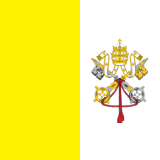
Play as · WW3 2026 · L1 · World's Smallest State · Holy See
Vatican - 2026
Vatican City is the world's smallest sovereign state by both area (0.49 km²) and population (about 800) - the institutional manifestation of the Holy See, with the dual political-and-religious authority of the Pope across the constitutional architecture institutionalized through the 1929 Lateran Treaties between the Holy See and the Italian state. The Holy See operates the world's most-extensive ecclesiastical-and-diplomatic network, with bilateral relations established with 184 sovereign states (and observer status at the United Nations and most major international organizations). The strategic identity is the soft-power micro-state - Vatican City has no economic-or-military weight, the Holy See's influence operates through moral authority, ecclesiastical hierarchy, diplomatic engagement, and the broader Catholic Church's institutional presence across 1.4 billion Catholics worldwide.
Starting position
Vatican City has the Pontifical Swiss Guard (about 135 personnel) for ceremonial-and-personal-security functions and the Gendarmerie Corps for internal security. Equipment is ceremonial. The post-Francis era leadership question is the central political-institutional fact (Francis's pontificate has been the most-influential since the post-WW2 era, the future-leadership question across the next conclave will substantially shape the next decade of Holy See positioning). The Vatican-China provisional agreement on bishop-appointments - first signed in 2018, renewed in 2020 and 2022 and 2024 - has been the most-controversial recent diplomatic-institutional development, with the substantive question being how the Holy See engages with the underground-and-state-recognized Catholic Church in China and the broader Sino-Vatican relationship. The Holy See engagement on Ukraine, Middle East, and broader conflict-mediation has been substantial under Francis.
What turns the campaign
What the Holy See wants is the global Catholic Church institutional architecture preserved through the post-Francis-era leadership transition, the Vatican-China provisional agreement framework continued and progressively expanded, the substantial Holy See diplomatic-engagement on global crises (Ukraine, Middle East, Sudan, broader humanitarian-and-conflict-resolution work) sustained, the institutional-financial reforms (the post-2014 economic-administration restructuring, the post-Vatican-Bank investigations, the broader transparency agenda) institutionalized, and the moral-and-soft-power positioning preserved as the principal external-influence asset. What the Vatican fears is a post-Francis-era leadership transition that produces internal-Catholic Church doctrinal-and-institutional crisis, a Vatican-China relationship breakdown that would compress the post-2018 framework, an Italian political shift that questions the post-1929 Lateran framework, and a global Catholic Church institutional crisis (the continuing clergy-abuse-and-cover-up question, the regional-conference and synodal-pathways tensions) that exceeds the institutional capacity to absorb.
Signature challenge
The soft-power micro-state
The Vatican's central strategic problem is sustaining the soft-power-and-moral-authority strategic identity in a global environment where the broader institutional-religious authority of the Catholic Church has been progressively contested by secularization trends, internal doctrinal-and-institutional disagreements, and the persistent clergy-abuse-and-cover-up question that the post-2002-onwards reform processes have addressed without resolving, and where the post-Francis-era leadership question will substantially shape the next decade of strategic positioning. The Holy See's diplomatic reach is real and substantial; the soft-power influence is genuine; the institutional architecture has demonstrated extraordinary durability. NationFall surfaces this as the Vatican campaign's defining tension: the world's smallest sovereign state whose strategic identity is the most-explicitly soft-power-and-institutional-authority positioning in the world, played out in a global environment where the underlying institutional-religious authority is being progressively questioned.
Try the Vatican campaign
Free demo. Pick WW3. Pick Vatican. The soft-power micro-state. The Holy See.
Play Free Demo as VaticanRegional: Italy · San Marino