

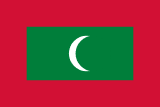
Play as · WW3 2026 · L1 · Indian Ocean Atoll Republic
Maldives - 2026
Maldives is governed by Mohamed Muizzu, elected in 2023 on a campaign promise to reverse the previous Solih government's deeply Indian-aligned posture and reorient toward China - a campaign promise he has substantially delivered, including the May 2024 withdrawal of the Indian helicopter and Dornier maritime-patrol aircraft contingent that had operated in the country since 2010. Population about 540,000, GDP around $15B PPP. The country comprises 26 atolls and over 1,100 individual islands across the central Indian Ocean - strategic real estate that any maritime power operating in the region cares about, and a climate-existential threat from sea-level rise that the political-strategic conversation in Malé cannot escape. The strategic identity is the small atoll republic that has demonstrated how thoroughly a single election can reorient a small-state foreign policy.
Starting position
The Maldives National Defence Force is about 4,000 active personnel, organized into Marines, Coast Guard (the principal maritime-sovereignty instrument), and small-unit ground forces. Equipment is light and oriented toward maritime patrol, search-and-rescue, fisheries enforcement, and counter-narcotics. The previous Indian helicopter detachment provided the principal medical-evacuation and search-and-rescue capability across the dispersed atoll geography; its withdrawal under the 2024 agreement transferred those functions to civilian Maldivian operators using Indian-supplied aircraft now operated under different legal arrangements. Chinese strategic engagement has expanded - the Hulhumale port, the Sinamale bridge, the Velana International Airport expansion - and the political relationship with Beijing was upgraded to comprehensive strategic cooperative partnership in early 2024.
What turns the campaign
What the Muizzu government wants is the Chinese strategic relationship deepened at the level the political pivot has promised, the Indian relationship managed at a lower-temperature equilibrium without producing economic damage (India remains a major trading partner and tourism source), the climate-resilience financing accessed at scale (the country is one of the most-quoted small-island developing-state cases at every UNFCCC negotiation), the tourism economy preserved as the primary foreign-currency earner against any Chinese-aligned polarization that would deter Western tourists, and the political consolidation continued without the kind of reversal that the 2018 election demonstrated can happen in either direction. What Maldives fears is an Indian active-pressure response (trade restrictions, financial pressure, intelligence operations against the political opposition that has remained Indian-aligned), a Chinese debt-distress crisis on the major infrastructure projects, and the climate-existential outcomes that no Maldivian government has the agency to substantially address.
Signature challenge
The atoll-pivot reversed
Maldives' central strategic problem is that the political pivot from Indian-aligned to Chinese-aligned has been executed at the speed and scale that demonstrates how thoroughly a small-state foreign policy can be reoriented in a single political cycle, and the same demonstration applies in reverse - the next election can pivot back, and the foreign relationships built or damaged in this cycle do not necessarily carry across. NationFall surfaces this as the Maldivian campaign's defining tension: a small atoll republic whose strategic real estate is genuinely valued by India, China, and the broader Indian Ocean maritime community, whose foreign-policy choices are constrained more by domestic political alternation than by geographic determinism, and whose long-term existential question (sea-level rise) is not addressable through any of the bilateral frameworks the political class spends its energy debating.
Try the Maldives campaign
Free demo. Pick WW3. Pick Maldives. Atoll republic. Pivot reversed. Climate clock.
Play Free Demo as Maldives