

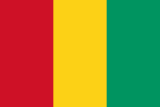
Play as · WW3 2026 · L1 · Doumbouya Junta · Bauxite-Iron Ore
Guinea - 2026
Guinea is governed by the military junta under Colonel Mamady Doumbouya - in power since the September 2021 coup that overthrew the third-term Alpha Condé administration, and operating through the post-coup transitional political-institutional architecture that has progressively extended the timeline to civilian-electoral return beyond the original commitments. Population about 14M, GDP around $50B PPP. The country holds the world's largest bauxite reserves (the Boké region production has been substantially expanded under Chinese-aligned mining cooperation, with Guinea now the world's largest bauxite exporter primarily to Chinese aluminum-smelting), and the Simandou iron-ore project - among the world's largest undeveloped iron-ore deposits, with Rio Tinto and the Chinese-aligned Winning Consortium WCS jointly advancing toward first production targeted for late 2025 - has been the principal recent strategic-economic positioning. The strategic identity is the mineral-rich West African junta state with the Chinese-aligned mining sector and the substantial post-coup transitional-political compression.
Starting position
The Guinean Armed Forces are about 12,000 active personnel, oriented toward border defense, internal security, and limited regional-cooperation deployments. Equipment is mixed and modest. The post-2021 junta architecture has progressively concentrated executive authority, the Doumbouya-government civilian-cabinet has rotated multiple times, and the political-opposition parties have been periodically constrained through legal-and-institutional measures. The Simandou project has been advancing through the multi-decade infrastructure-construction phase - the railway from the iron-ore deposits through Guinea to a new deepwater port at Forécariah, the port itself, and the broader logistics architecture - at substantial Chinese-and-Rio-Tinto-financed scale. The bauxite mining sector at Boké has continued at increasing scale through the post-2021 period.
What turns the campaign
What Guinea under Doumbouya wants is the post-coup political-institutional consolidation completed through whatever transitional-electoral framework the junta architecture eventually produces (the 2025 referendum and subsequent elections were the most recent commitments, with continued timeline compression), the Simandou iron-ore project operationalized at the projected first-production scale, the bauxite-mining sector expanded at the level the Chinese-aligned demand can absorb, the regional-cooperation through ECOWAS preserved at whatever level the post-AES-withdrawal architecture can support (Guinea is not in the AES but has been ECOWAS-suspended through the post-coup period), and the bilateral relationships with Russia, China, and the broader non-Western partners deepened. What Guinea fears is a Simandou project setback that would have multi-decade economic consequences, an ECOWAS or broader Western coordinated pressure that exceeds the post-2021 management capacity, a domestic political-institutional crisis if the transitional-electoral framework breaks down at scale, and a regional Sahel-spillover that the post-2021 environment has not had to absorb at the AES-junta scale.
Signature challenge
The mineral state under junta
Guinea's central strategic problem is converting the world's largest bauxite reserves and the Simandou iron-ore strategic-economic positioning into operational delivery and revenue-distribution outcomes through a post-2021 junta political-institutional architecture whose legitimacy is contested both internally (the political opposition's continuing pressure for civilian-electoral return) and externally (ECOWAS suspension, Western coordinated pressure for democratic transition). The mineral-economy potential is real and growing; the political-institutional capacity to deliver is the principal scarce resource. NationFall surfaces this as the Guinean campaign's defining tension: a mineral-rich West African state whose strategic-economic positioning has expanded substantially across the past decade, played out under a junta political-institutional architecture whose continuity depends on factors that the comparator post-coup states have demonstrated to be progressively constrained.
Try the Guinea campaign
Free demo. Pick WW3. Pick Guinea. Bauxite. Simandou iron-ore. Junta architecture.
Play Free Demo as GuineaRegional: Sierra Leone · Senegal · Mali