

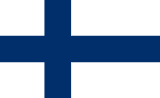
Play as · WW3 2026 · L1 · NATO · 1,340km Russia Border
Finland - 2026
NATO's newest full member as of April 2023 and the alliance's longest direct land border with Russia at 1,340 kilometers. Finland is small (5.6M people, GDP around $400B PPP), but it kept conscription through the entire post-Cold-War era when most of Europe was demobilizing, retained a wartime mobilizable force around 280,000, and built a total-defense doctrine that integrates civilian society into the military planning case. The strategic identity is institutional memory - the Winter War of 1939–40 is studied in Finnish staff colleges as a current operations problem, not a historical episode.
Starting position
The Finnish Defence Forces are a roughly 23,000-strong active component that scales rapidly via mobilization. The air force has placed the largest Western-European F-35A order outside the UK (64 aircraft replacing the F/A-18 Hornet fleet, deliveries through the early 2030s), the army runs Leopard 2A6 main battle tanks alongside K9 self-propelled artillery batteries acquired from South Korea, and the navy operates fast-attack craft and minelayers calibrated to the Gulf of Finland's archipelagic geography. Defense spending sits at or above the 2% NATO target. The total-defense doctrine binds civilian shelters, food reserves, fuel stockpiles, and the National Emergency Supply Agency into the wartime planning architecture in a way unique among Western states.
What turns the campaign
What Finland wants is the NATO accession fully operationalized into joint planning, command relationships, and pre-positioned support, the Baltic Sea kept as a NATO lake (now that Finland's accession plus Sweden's have closed the geographic gap), the Russia border fortified and surveilled with the seriousness the threat assessment justifies, and the F-35 transition delivered on schedule. What Finland fears is a Russian provocation - hybrid, gray-zone, migration-weaponized as in the 2023 border closures, or kinetic on a small scale - that tests Article 5 thresholds before NATO has fully integrated Finland's defense, an Arctic dimension that the alliance has not yet planned for at scale, and a domestic political reversal that questions the procurement commitments the new defense posture requires.
Signature challenge
The 1,340 kilometers
Finland's central strategic problem is the border itself. NATO has spent thirty years thinking about its eastern flank in terms of a Polish-Baltic-Romanian arc with a heavily fortified Suwałki Gap; with Finnish accession the alliance has acquired the longest direct Russia-NATO border anywhere on the continent, in terrain (forest, lakes, near-Arctic latitudes) that none of the existing eastern-flank planning constructs handle natively. NationFall surfaces this as the Finnish campaign's defining tension: a country whose entire defense doctrine was built around being the new flank holds its line alone, and is now a treaty-protected member whose flank is the alliance's flank - and the alliance's planning has not yet caught up.
Try the Finland campaign
Free demo. Pick WW3. Pick Finland. The newest member with the longest border.
Play Free Demo as Finland