

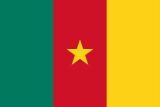
Play as · WW3 2026 · L1 · Biya Continuity · Anglophone Crisis
Cameroon - 2026
Cameroon is governed by Paul Biya - in continuous power since 1982, the longest-serving non-royal head of state in Africa and one of the longest-serving in the world - and the country whose post-2016 Anglophone Crisis in the Northwest and Southwest regions has been the central internal-political-and-security challenge of the past decade. Population about 30M, GDP around $130B PPP. The northern frontier with Nigeria has been the principal external-security front against Boko Haram and the ISWAP successor groups since the 2014-2015 escalation. The strategic identity is the bilingual French-and-English central African state with the Biya-era political-institutional continuity, the Anglophone Crisis that contests that continuity, and the regional-security cooperation that has been substantially reset since the 2023-onwards French-African crisis.
Starting position
The Cameroonian Armed Forces are about 25,000 active personnel, oriented toward border defense (the Nigerian frontier counter-Boko-Haram operations, the Central African Republic frontier, the Chad frontier), the Anglophone-region internal-security operations (substantially documented human-rights concerns), and limited regional-cooperation deployments. The Biya-era political-institutional architecture has progressively concentrated executive authority and reduced institutional check-and-balance functions. The Anglophone Crisis - emerged from the 2016 lawyers' and teachers' strikes against the marginalization of Anglophone legal and educational institutions, escalated through 2017 declarations of independent Ambazonia by separatist factions, and has produced a multi-front low-intensity insurgency with substantial population displacement - continues at reduced operational tempo from the 2018-2020 peak but without political settlement.
What turns the campaign
What Cameroon under Biya wants is the political-institutional continuity preserved through whatever succession arrangement the closed political system can produce (Biya is in his nineties, the succession question is structurally imminent), the Anglophone Crisis contained without political settlement that would require federalist constitutional reform, the Boko Haram and ISWAP northern threat managed through Lake Chad Basin Commission and Multinational Joint Task Force cooperation, the French-Cameroonian relationship preserved against the post-Sahel-juntas regional reset that has compressed French-African engagement, and the Chinese economic engagement maintained at the level the post-2010 development partnership has institutionalized. What Cameroon fears is a Biya succession crisis that the closed political system has not produced an institutional answer to, an Anglophone Crisis escalation that produces large-scale humanitarian intervention demands, and a Boko Haram resurgence that exceeds the post-2020 containment capacity.
Signature challenge
The Biya succession question
Cameroon's central strategic problem is that the political-institutional architecture has been substantially shaped by Paul Biya's 43-year continuous tenure, the closed political system has not produced an institutionally-credible successor, the Anglophone Crisis has demonstrated how thin the unitary-state legitimacy is in the territorially-marginalized regions, and the inevitable succession will arrive into an environment where the institutional capacity to manage transition is the principal scarce resource. NationFall surfaces this as the Cameroonian campaign's defining tension: a central African state whose political-institutional continuity has been the personal-leader-driven architecture of one extraordinary tenure, played out as the demographic-and-political reality of that tenure approaches its natural conclusion.
Try the Cameroon campaign
Free demo. Pick WW3. Pick Cameroon. Biya continuity. Anglophone Crisis. Succession imminent.
Play Free Demo as CameroonRegional: Nigeria · Chad · Central African Republic