

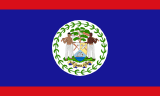
Play as · WW3 2026 · L1 · CARICOM · Guatemalan Claim
Belize - 2026
Belize is the only English-speaking Central American state and the only Caribbean Community member that sits on the Central American mainland - population about 410,000, GDP around $5B PPP, an economy weighted toward tourism (the Belize Barrier Reef, the second-largest in the world), agriculture, and the offshore-finance services that successive governments have tried to develop within the international tax-transparency frameworks. The Guatemalan territorial claim - covering more than half of internationally recognized Belizean territory - has been the central foreign-policy fact since independence in 1981 and has been referred to the International Court of Justice for binding settlement under the 2008 Special Agreement, with the case substantively underway since 2019. The strategic identity is the small Anglophone state on the Spanish-speaking mainland, with the British residual military presence and the Caribbean diplomatic affiliation that distinguish the country from every neighbor.
Starting position
The Belize Defence Force is about 1,500 active personnel, organized as ground regiments and a small air wing and coast guard, oriented toward border defense (the Guatemalan boundary, the Mexican boundary, and the Sarstoon River dispute zone), maritime patrol of the substantial EEZ, and counter-narcotics interdiction in cooperation with US Joint Interagency Task Force South. The British Army Training Support Unit Belize (BATSUB) maintains a small but operationally important British military training presence - the jungle-warfare and tropical-environment training that the British armed forces would otherwise have to develop on commercial-cost terms. Equipment includes the Coastal Patrol vessels supplied through US, UK, and Taiwanese cooperation, plus light infantry and patrol equipment.
What turns the campaign
What Belize wants is the ICJ ruling on the Guatemalan claim delivered within the decade and substantively favorable (the case is pending, the proceedings have been delayed several times, the binding nature of the eventual ruling is the central political-strategic asset Belize has spent four decades pursuing), the British BATSUB presence preserved (the United Kingdom periodically considers relocation, the Belizean political establishment has lobbied for continued presence as the residual security guarantee), the offshore-finance regulatory environment maintained against international pressure, the tourism economy preserved against any regional security or climate crisis, and the Sarstoon River boundary dispute managed without producing the kind of incident that escalates the bilateral situation. What Belize fears is a Guatemalan unilateral move on the ICJ-pending territory before the binding ruling, a British BATSUB withdrawal that removes the residual security guarantee, and a Caribbean-CARICOM polarization that compresses the diplomatic-affiliation room.
Signature challenge
The pending ICJ ruling
Belize's central strategic problem is that the country's territorial integrity rests on an ICJ proceeding whose outcome is uncertain, whose timeline is extended, and whose binding nature depends on Guatemalan compliance with a ruling Belize hopes will be substantially in its favor. The 2008 Special Agreement that created the ICJ pathway was a major Belizean diplomatic achievement; the substantive proceeding's slow pace is a continuing political challenge. NationFall surfaces this as the Belizean campaign's defining tension: a small state whose entire foreign-policy energy for decades has been the management of the Guatemalan claim, played out in an international-legal mechanism whose effectiveness depends on Guatemalan acceptance of an outcome the Guatemalan political class may not be prepared to accept.
Try the Belize campaign
Free demo. Pick WW3. Pick Belize. The English-speaking Central American with the ICJ case.
Play Free Demo as Belize