

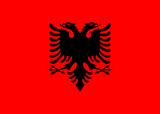
Play as · WW3 2026 · L1 · NATO Adriatic
Albania - 2026
NATO member since 2009 and one of the alliance's success stories of the 2000s expansion - a country that emerged from forty-five years of one of Europe's harshest Stalinist isolations into a coherent alignment with the Western order. Population 2.8M, GDP around $70B PPP, Adriatic and Ionian coastline opposite Italy, EU accession track active. The strategic identity is the rapid Westernization - every alignment lever (military, economic, cultural, diasporic) pulled in one direction, fast, without the political ambiguity that complicates other Balkan members.
Starting position
The Albanian Armed Forces are small (about 8,000 active) and have been integrating with NATO procurement and doctrine since 2009. The signature recent development is the reactivation of Kuçovë Air Base, a Cold War MiG-21 facility that NATO has spent more than $50M restoring as a forward operating location for alliance aircraft - the first new NATO base in the western Balkans. Equipment is mixed and lighter than most NATO militaries, but the orientation is unambiguous and the operational integration is deeper than the size suggests. The Albanian-American relationship is unusually strong - pro-American sentiment runs deeper than in almost any other European state, a function of the 1999 Kosovo intervention and the diasporic ties to the United States.
What turns the campaign
What Albania wants is the EU accession process completed within the decade (currently in negotiations, opened June 2022), the Kuçovë and Pasha Liman naval-base reactivations developed into full forward-operating-base status, the Kosovo question stabilized - recognition extended by the remaining holdout Western states (Spain, Greece, Cyprus, Romania, Slovakia among EU non-recognizers), Serbia normalization advanced - and the Greater Albanian or pan-Albanian question kept off the diplomatic agenda even as cultural and economic integration with Kosovo deepens. What Albania fears is a Serbian crisis (Banjska 2023 was a warning) that demands Albanian response and exposes capacity gaps, an EU enlargement reversal that strands Tirana in the accession queue with no end date, and any US disengagement from the Balkans that removes the security guarantor whose presence has been load-bearing since 1999.
Signature challenge
The Kosovo entanglement
Albania's central strategic problem is that its identity, security posture, and foreign policy are all entangled with Kosovo - the ethnic-Albanian-majority state whose 2008 independence Tirana championed, whose recognition Albania pushes for in every multilateral forum, and whose Belgrade-Pristina dialogue Albania participates in adjacent to. NationFall surfaces this as the Albanian campaign's defining tension: a small NATO member whose strategic agenda runs through a partner state that is not a NATO member, whose security depends on a status that five EU member states still refuse to recognize, played out against a Serbia whose own NATO and EU trajectories remain unresolved.
Try the Albania campaign
Free demo. Pick WW3. Pick Albania. The Adriatic flank, fully aligned.
Play Free Demo as Albania