

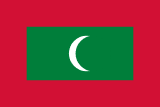
Play as · WW2 1939 · L1 · British Protectorate · Indian Ocean
Maldives - 1939
The Maldives in 1939 is the British protectorate sultanate under Sultan Hassan Nooraddeen II - in office since 1935 - operating through the post-1887 protectorate framework that institutionalized British control over external affairs and defense while preserving the sultan's domestic authority through the broader Cetheya-and-traditional-political architecture. Population about 80,000 across approximately 200 inhabited atolls and reef islands. The strategic identity is the British protectorate sultanate with the substantial Indian Ocean atoll-archipelago strategic geography that will produce the post-1942 Royal Air Force Station Gan establishment at the Addu Atoll (one of the most-southern British air-and-naval facilities of the WW2 Indian Ocean operations), the limited indigenous economic activity centered on coconut-and-fishing-and-cowry-shell-trade, and the substantial historical-cultural Buddhist-then-Islamic conversion legacy that has shaped the political-cultural architecture for centuries.
Starting position
The Maldives has minimal military forces in 1939 - the small Royal Maldives Bodyguard and the traditional-territorial-defense formations totaling perhaps a few hundred personnel. Equipment is minimal. The defense-against-external-threat function is institutionalized through the British protectorate framework rather than through indigenous military capacity. The economic foundation is substantially subsistence-fishing and coconut-and-derivative-products with limited external trade through the British-Indian-administered framework. The strategic-geographic position has been continuously valued by maritime powers - the post-1942 RAF Gan establishment will substantially convert the Addu Atoll into one of the principal British Indian Ocean air-and-naval-staging facilities for the broader Eastern Theatre operations.
What turns the campaign
What the Maldives in 1939 wants is the British protectorate framework preserved at the level the post-1887 architecture has institutionalized, the Sultan's domestic-political authority preserved without producing the kind of inter-island political-economic tensions that the broader atoll-archipelago geography periodically generates, the limited external-engagement maintained at the level the British-India framework supports, and the strategic-geographic position preserved as a continuing source of British-strategic-engagement and the modest related economic flows. What the Maldives fears is the looming Japanese threat to the Indian Ocean (the post-1941 Indian Ocean Raid and the broader Japanese maritime expansion will produce substantial British-strategic-response that includes the post-1942 RAF Gan and other forward-deployment facilities), a British strategic-resource-redirection that compresses the protectorate-engagement, and a domestic political-institutional crisis that the small population and limited institutional capacity is stretched to manage.
Signature challenge
The Indian Ocean atoll protectorate
The Maldives' central strategic problem in 1939 is sustaining the British protectorate framework and the substantial sultanate political-institutional architecture in a regional environment where the looming Japanese threat to the Indian Ocean will produce substantial British-strategic-response across the post-1941 period that the protectorate-and-strategic-geography positioning will substantially-mediate. The British-aligned framework is the principal external-relations architecture; the atoll-archipelago strategic geography is the principal source of continuing external-strategic-engagement; the small population and limited institutional capacity are the principal continuing constraints. NationFall surfaces this as the Maldivian campaign's defining tension: an Indian Ocean atoll-protectorate whose strategic identity is the most-isolated political-institutional consolidation in the broader regional environment, played out in a strategic-geographic position whose value to maritime powers will be substantially elevated by the looming wartime expansion.
Try the Maldives campaign
Free demo. Pick WW2 1939. Pick Maldives. The Indian Ocean atoll protectorate.
Play Free Demo as MaldivesRegional: United Kingdom · Japan